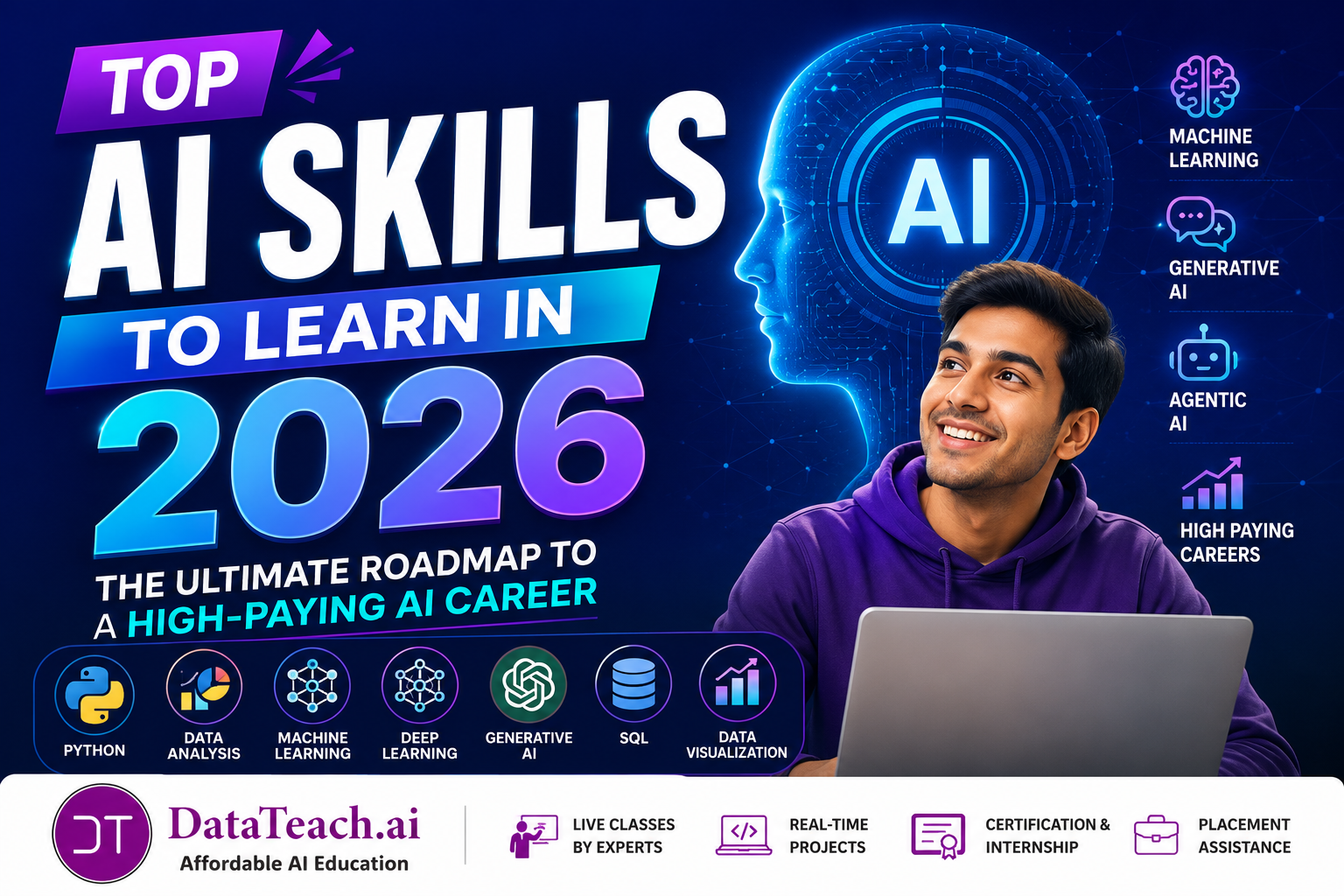
Top AI Skills to Learn in 2026: The Ultimate Roadmap to Build a High-Paying Career
Introduction
Artificial Intelligence (AI) has become one of the most valuable skills in today's job market. Businesses are investing in Generative AI, AI automation, data analytics, and intelligent applications to improve productivity and customer experience. Whether you are a student, recent graduate, or working professional, learning AI in 2026 can significantly improve your career prospects.
This guide explains the essential AI skills, the order in which you should learn them, the tools you need, and the projects that employers value.
Why Learn AI in 2026?
• AI jobs continue to grow across industries.
• High salary potential.
• Remote and global opportunities.
• Strong demand for Python, Machine Learning, Generative AI and Agentic AI.
• AI is being adopted in healthcare, finance, education, retail, manufacturing and cybersecurity.
1. Learn Python Programming
Python is the foundation of AI. Focus on variables, data types, loops, functions, object-oriented programming, file handling, exception handling and libraries such as NumPy, Pandas and Matplotlib.
2. Learn Data Analysis
Understand how to collect, clean and analyse data. Learn exploratory data analysis, feature engineering and visualisation using Pandas, NumPy and Matplotlib.
3. Learn Mathematics for AI
Build confidence in statistics, probability, linear algebra and basic calculus. You only need practical understanding to start developing AI models.
4. Machine Learning
Study supervised and unsupervised learning, regression, classification, clustering, model evaluation, feature selection and hyperparameter tuning using scikit-learn.
5. Deep Learning
Learn neural networks, TensorFlow, PyTorch, CNNs, RNNs and Transformers. Deep Learning powers computer vision, speech recognition and modern AI assistants.
6. Generative AI
Master prompt engineering, Large Language Models (LLMs), Retrieval-Augmented Generation (RAG), AI APIs and workflow automation using modern AI tools.
7. Agentic AI
Agentic AI enables autonomous agents to plan tasks, use tools, retrieve information and complete workflows with minimal human intervention.
8. SQL and Data Visualisation
SQL is essential for querying databases. Combine SQL with Power BI or Tableau to create dashboards and communicate insights effectively.
Real-World AI Projects
• House Price Prediction
• Customer Churn Prediction
• Resume Screening System
• AI Chatbot
• Face Recognition
• Medical Image Classification
• Recommendation System
• Sales Forecasting Dashboard
Six-Month AI Roadmap
Month 1: Python & Git
Month 2: Data Analysis & Statistics
Month 3: Machine Learning & SQL
Month 4: Deep Learning
Month 5: Generative AI & Prompt Engineering
Month 6: Agentic AI, Portfolio, Resume & Interview Preparation
Career Opportunities
• AI Engineer
• Data Scientist
• Machine Learning Engineer
• Data Analyst
• Computer Vision Engineer
• NLP Engineer
• Prompt Engineer
• AI Automation Engineer
Common Mistakes to Avoid
• Skipping Python fundamentals
• Learning too many tools at once
• Avoiding projects
• Not practising coding regularly
• Ignoring GitHub portfolio development
Why Choose DataTeach.ai?
DataTeach.ai offers affordable AI education with live instructor-led classes, hands-on projects, internship support, mock interviews, resume building and placement assistance. The curriculum is designed for beginners and career switchers who want practical, job-ready AI skills.
Final Thoughts
Artificial Intelligence is no longer optional for technology careers. By following a structured roadmap and building practical projects, you can become job-ready in AI. Start with Python, progress to Machine Learning, Deep Learning, Generative AI and Agentic AI, and continuously strengthen your portfolio.
Frequently Asked Questions
Q. Can I learn AI without coding?
A. Learning Python is strongly recommended because most AI tools and frameworks rely on it.
Q. How long does it take to become job-ready?
A. With consistent learning, many beginners build a strong portfolio within six months.
Q. Is mathematics mandatory?
A. Basic statistics and linear algebra are sufficient to begin.
Q. Which programming language is best for AI?
A. Python remains the industry standard.